
Changing Economic Lifeblood
from Oil
to Ingenuity.
"Change is not required. Survival is not mandatory."
— Dr. W. Edwards DemingAs noted by 10 US Presidents, foreign oil addiction builds a repeating Path to War (Iraq, Afghanistan, Venezuela, Iran). JPods was founded by a West Point graduate and infantry veteran to end that addiction; to power urban mobility within a solar budget (patent 6,810,817).
JPods solar mobility networks — converting traffic costs into sustainable, walkable cities.
Mobility Is
Physical Liberty.
The Constitution mandates we "secure the Blessings of Liberty to ourselves and our Posterity." Mobility is physical liberty.
Society prospers when individuals profit from the division of labor by having equality of access to on-demand mobility regardless of age, ability, or wealth.
Six reasons to act now ↓Mobility is the physical manifestation of liberty. Life requires energy.
Solving Traffic.
Commutes and Cargo.
Replicate the Internet to build the Physical Internet®.
- High-speed and heavy lift (fiber optics) is railroads and aircraft
- Middle-mile (WiFi) is JPods, 1 to 35 miles.
- Last-mile (Bluetooth) is walking, bikes, Uber, ... 0-5 miles.
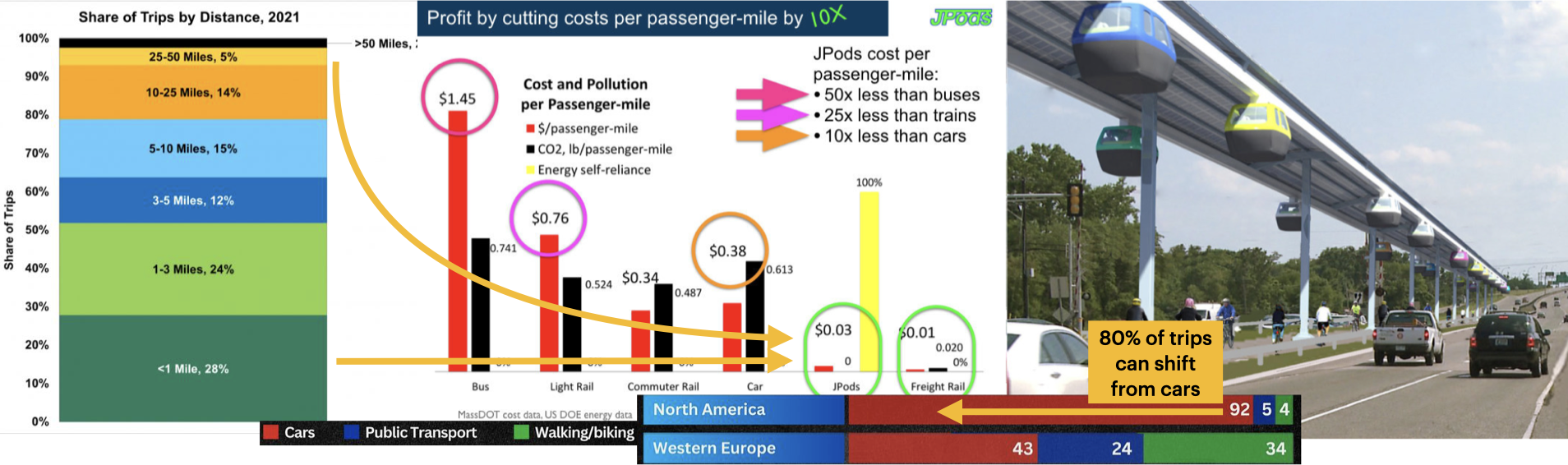
92% of trips are under 25 miles — JPods' middle-mile sweet spot. JPods cost $0.03/passenger-mile vs $1.45 for buses, $.76 for rail, and $.38 for cars.
Difficult to define is "Proximity" — closeness to resources. JPods' ability to deliver cargo to neighborhood shops and fabricators, just as big-box stores get containers delivered, will be significant.
Mobility is the physical manifestation of liberty. Life requires energy.
Start Small.
Iterate Relentlessly.
Remove political influence as THE dominant factor in transit decision. Privately fund networks in profitable niches to speed deployment and rally public support. Correct a century of stagnation. Freight railroads are 188 times more efficient that cars (470 ton-mpg versus moving a 200 pound person with the 25 mpg efficiency of the Model-T. Despite great efficiency, political influence replaced 45% freight railroads with roads.
Implement the 5x5 Free Market: privately funded networks 5 times more efficient than roads pay 5% of gross transport revenues to use airspace over approved public rights of way. Free markets removes political favors.
Innovate at the pace innovators can attract capital to convert traffic costs into value. Currently innovation in cars limited to rate people can afford to replace their car.
America built 260,000 miles of freight railroad in the 1800s with private capital — no taxpayer burden, driven entirely by return on investment and speed of execution. That model created the economic backbone of a continent.
JPods builds on that same principle. Private capital funds the network. The city provides only a Right-of-Way agreement. JPods pays 5% of gross revenues back to Rights-of-Way holders — turning public infrastructure into a revenue stream, not a budget line.
- Taxpayer funded
- Political timelines
- Cost overruns chronic
- Revenue to government
- Private capital only
- ROI drives speed
- 18–24 month build
- 5% revenue to ROW holders
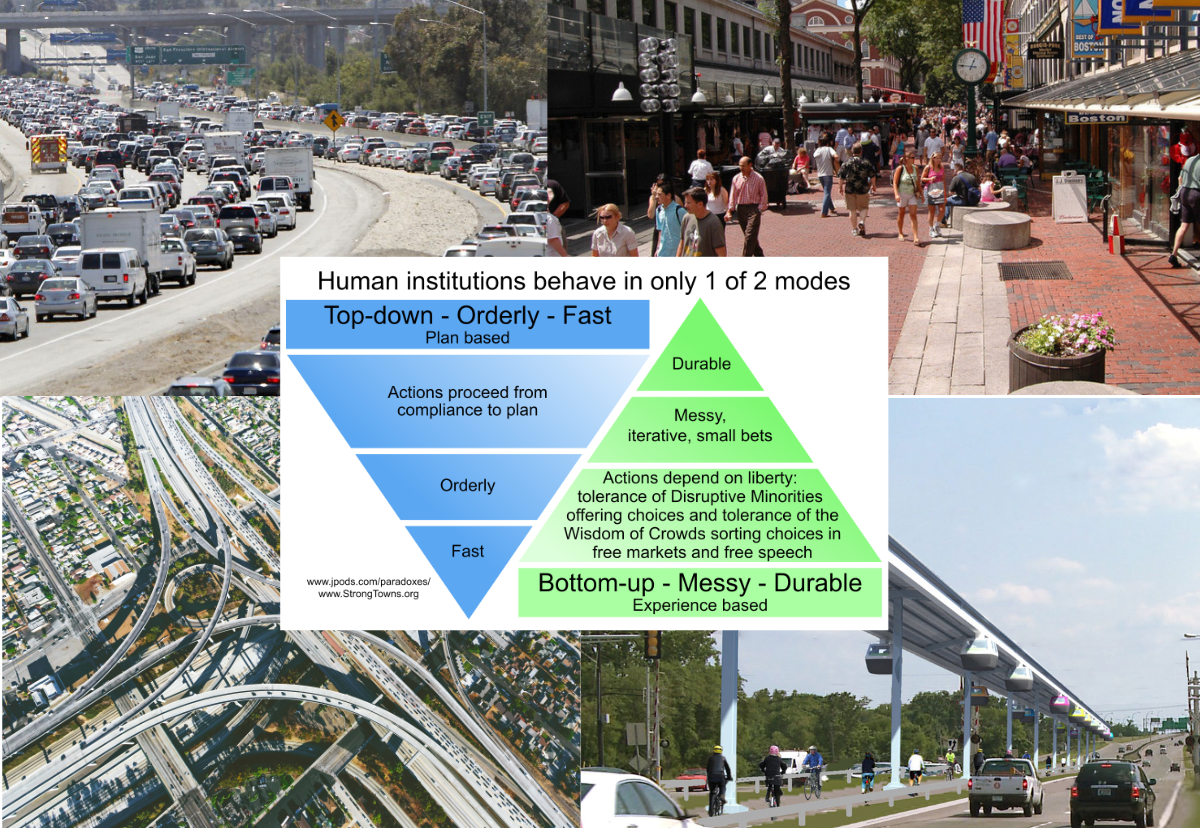
Highways are a top-down, plan-based solution — orderly and fast to build, but not durable. They fragment communities, consume land, and depend on cheap oil that is running out. Walkable cities are bottom-up, experience-based — messy, iterative, and durable. JPods enables the transition by removing enough cars that proximity, walking, and cycling become viable again.
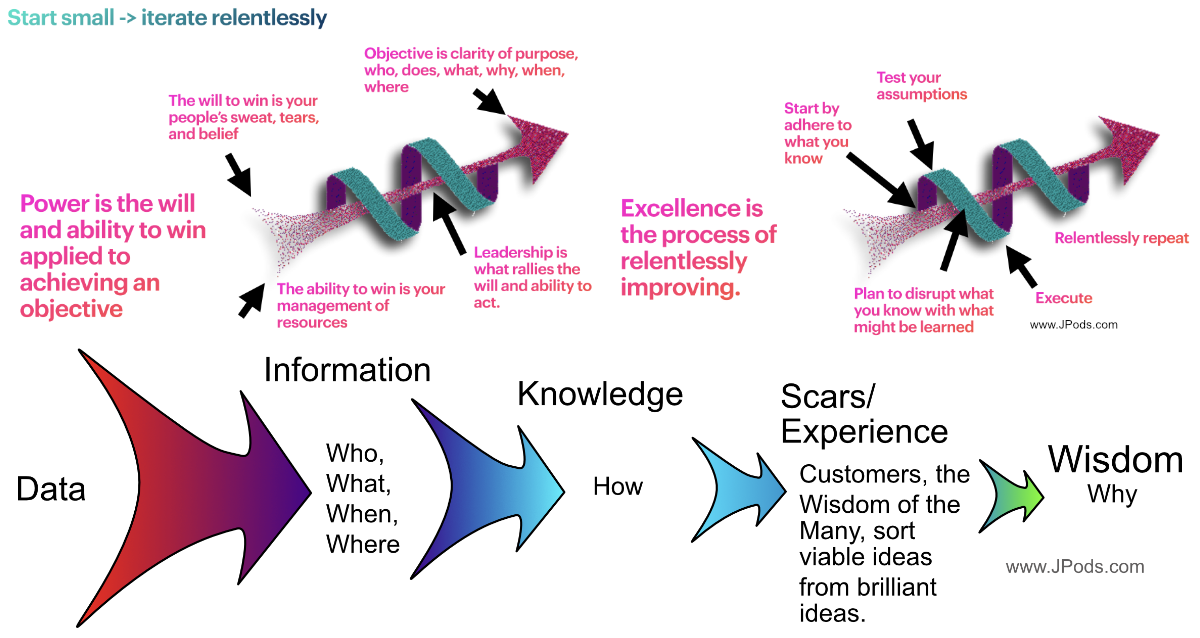
The philosophy behind every JPods deployment — test, learn, scale.
Three Reasons to Act Now
Traffic congestion, oil dependence, and car-centric sprawl aren't inevitable — they're choices. Here is why changing those choices matters, and why now.
Walkable Cities Are the Source of Prosperity.
Research shows that parts of cities with Walk Scores above 70 pay for their own infrastructure. Below 70, city revenues fall short of maintenance costs — subsidizing sprawl with debt. Dense, walkable, transit-connected neighborhoods generate more tax revenue per acre than any highway corridor.
Revenues & Losses & Fiscal SustainabilityLife Requires Energy. Cheap Oil Is Ending.
Every civilization in history that outran its energy supply collapsed. The Dallas Federal Reserve, EIA, and oil companies themselves warn that US shale production will decline 20–30% quickly in the late 2020s. War, instability, and price shocks are not hypotheticals — they are a replay after US Peak Oil in 1970. We have passed Peak Fracking.
Energy SecurityCongestion Adds Cost Without Creating Value.
Americans waste a full work-week per year sitting in traffic — $121 billion in lost productivity annually. Moving two tons of steel to move one person is less than 1% efficient. Parking is a problem. These are pure losses extracted from families, businesses, and cities with nothing given back.
Economic Drain → Economic EngineA Network of Horizontal Elevator™
Your Pod is Waiting for you
Walk towards any station. Your phone and face alert the station to have a pod ready based on your normal activity or what you put into your phone app. Machines wait for you, not you waiting for a bus. No schedules, no route numbers, no sharing with strangers.
Non-Stop to Destination
Your pod travels directly from your origin to your destination; above traffic, no lights, no stops, no congestion. Average speed exceeds cars, trains, or buses — 24x7 service.
Powered by Sunshine
Solar panels above the guideway power the entire network. 40,000 vehicle-miles of power are collected per mile per day. Zero fuel, zero emissions, zero grid dependency. Paybacks are based on replacing 10,000 car-miles per mile per day.
50 Years of Evidence
President Nixon: "At the end of this decade, in the year 1980, the United States will not be dependent on any other country for the energy we need. We will hold our future in our hands alone.". He sent his daughter to open the Morgantown's PRT in 1972 — it has delivered oil-free, on-demand mobility since. It had two minor injuries recorded in the period 1.8 million Americans have been roadkilled.
Theme Park Thrill rides have 3.7 injuries per million. Roads have 11,200 serious injuries per million. Radically safer standards can be enforced.
Walter Cronkite covered Tricia Nixon opening the world's first digital transport network at West Virginia University. Tricia's comment to the NY Times, "More fun than Disneyland".
Scott Olson, the creator of Roller Blades, contracted with JPods to use our robots. SkyRide is on three Carnival Cruise Ships and was rated Best Cruise Ship Feature of 2016 and 2017.
The Morgantown Personal Rapid Transit system was built as a direct response to oil dependence.
It has operated for over 54 years, proving that automated, grade-separated, on-demand
mobility is not only possible — but vastly safer and more efficient than roads.
In that same 50-year period, the US highway system killed 1.8 million Americans,
caused climate change, funded adversaries with petrodollars, and required continuous military
intervention to protect supply lines.
JPods is the modern evolution: lighter vehicles, solar power, smartphone dispatch,
privately financed networks that cost taxpayers nothing to build or operate.
"Sunshine is spread out thin and so is electricity. Perhaps they are the same… There must surely come a time when heat and power will be stored in unlimited quantities in every community, all gathered by natural forces." — Thomas Edison, 1910
JPods, self-disciplined to be powered within a solar budget.
The Story Gets Told
JPods founder Bill James has presented the case for solar mobility at TED conferences and been featured in international documentary film. Watch the talks and the documentary below.
Mobility & Liberty
Bill James makes the constitutional and economic case for solar mobility — why physical liberty requires energy independence, and why the highway monopoly is a repeating path to war.
Watch on YouTube ↗The Physical Internet®
JPods as the middle-mile layer of a Physical Internet — safe, congestion-free, on-demand personal mobility and cargo transport for trips under 35 miles.
Watch on YouTube ↗The Future of Transportation
Wu-Tang Clan founder GZA investigates the future of transportation — visiting Bill James and JPods alongside self-driving cars and magnetic hoverboards. JPods appears at 9:30.
A rare mainstream documentary that places JPods alongside the most credible emerging mobility technologies — framed as the urban middle-mile answer between last-mile walking and long-haul hyperloop.
Watch on Red Bull TV ↗Note: Please confirm the TEDxMidAtlantic YouTube link — both talks currently share the same URL.
Car-Centric vs. Walkable
Economic Drain
- Infrastructure costs exceed revenues — especially below Walk Score 70
- Families spend $9,000+/year per car (AAA estimate) leaving the local economy
- Oil dollars flow out of region, funding instability abroad
- Congestion wastes a work-week per year per commuter
- CO₂, particulates, and noise degrade health and property values
- The elderly, disabled, and poor are mobility-imprisoned
Economic Engine
- Walk Score 70+ neighborhoods pay for their infrastructure
- Car savings stay local — recirculating in the community economy
- Solar-powered mobility keeps energy dollars local and renewable
- Non-stop, on-demand travel returns time to citizens
- Zero emissions, grade-separated — cleaner air, safer streets
- Universal access — mobility for every age, ability, and income
Why Not Cars, Buses, Rail, or Gondola?
City officials tend to look at transport options from the perspective of how they can get the most Federal dollars. JPods will fund how to make the most walkable city. Walkable cities are net positive cash flow.
| Criterion | More Cars | Ride Services | Bus / BRT | Monorail | Gondola | JPods ® |
|---|---|---|---|---|---|---|
| Safety (Grade-Separated) | ● | ● | ● | ● | ● | ● |
| Energy Efficiency | ● | ● | ● | ● | ● | ● |
| Solar Powered | ● | ● | ● | ● | ● | ● |
| Privacy / Security | ● | ● | ● | ● | ● | ● |
| Contagion Suppression | ● | ● | ● | ● | ● | ● |
| Access (Frequent Stations) | ● | ● | ● | ● | ● | ● |
| Travel Time (Wait + Travel) | ● | ● | ● | ● | ● | ● |
| Congestion Relief | ● | ● | ● | ● | ● | ● |
| Station Cost | ● | ● | ● | ● | ● | ● |
| System Build Cost / Mile | ● | ● | ● | ● | ● | ● |
| Land Use | ● | ● | ● | ● | ● | ● |
| Overall Score (/ 10) | 5.0 | 4.2 | 5.3 | 3.3 | 6.3 | 10.0 |
Source: JPods Las Vegas Proposal, 2020. ● Green = advantage · ● Yellow = partial · ● Red = disadvantage
Start Small.
Iterate Relentlessly.
The book Nothing Like It in the World is a case study for how to radically retool infrastructure:
- Privately fund the networks to force focusing on network efficacy.
- Focus on the customer in single purpose companies:
- Technology: JPods creates and enforces standards.
- Construction: Network Construction Companies (NCCs) build the networks. Customers is the LMCs.
- Operating: Local Mobility Companies (LMCs) own and operate the networks. Customers are the farebox payers.
Certification & Limit Risk
The city signs a Letter of Intent to adopt the 5×5 Free Market and signs the Rights of Way Contract for JPods as it does for power and communications networks. This signals to investors that investments are safe from bureaucratic delays and cost overruns.
Kitty Hawk Network — ~150 meter
JPods funds a $5 million certification network is erected to limit capital risk as the regulatory process is completed and construction crews are trained.
Geotech & Ramp the Supply Chain
As with the railroads, a construction crew is large and about 9 months long (from survey to certification) and is moving at 1 to 10 miles per day. Survey crews lead, followed by those installing footings, moving/burying power lines, followed by crews staging guideways, assembly crews, solar crews, and finally certification crews.
Operations & Expansion
The certified network opens to the public. JPods pays 5% of gross revenues back to the Rights of Way holders. As ridership grows, the network expands — each mile making walking, cycling, and transit safer for everyone.
As Many Types as There Are Needs
Passenger
Same as a private car, 1-4 people, 6 if some are children. Room for luggage, 2 bikes, and wheelchair accessible. Mobility is personal — never shared with strangers.
Cargo
Palletized payloads (1,100 pounds) stream continuously through the network — feeding and supplying a city alongside passengers.
Medical
Carries a gurney, EMS crew, and supplies. Direct routing to medical facilities — no traffic delays in emergencies.
Private
Like owning your own car. Stores itself when not in use, meets you when called. Your schedule, your pod.
Social & Scenic
Open-air and tourist configurations add to the experience — generating ridership and showcasing the city.
Detachable
Clamps to a vehicle chassis for off-guideway travel. Focus is cargo, utility, and private-last-mile.
Join the Movement
Design networks. Learn the technology. Follow the industry as it shifts from oil to ingenuity.
Design a JPods Network
Students, engineers, and planners — use JPods design tools to model solar mobility networks for your community. Viable designs qualify for co-founder funding.
jpods.com/STEM →Model Your City's Network
RouteTime™ calculates travel times, required vehicles, walk-ride-walk distances, and cost per passenger-mile for any proposed JPods corridor.
jpods.com/design →The Sector Is Moving
JPods, Glydways, SwyftCity, and the broader PRT ecosystem are advancing rapidly. Follow the shift from congestion to solar-powered mobility networks.
jpods.com/PRTnews →Join the Transition
Every role matters. Cities provide the right of way. Investors provide the capital. Innovators design the networks. Media spreads the word. Together we change economic lifeblood from oil to ingenuity.
City Officials
Issue a Right-of-Way agreement. JPods handles permitting, funding, and construction — zero taxpayer cost. We provide network designs and economic assessments for your city.
Request a city briefing →Investors
JPods networks are privately funded, revenue-generating infrastructure. Explore co-founder and franchise operator opportunities — built on the 1800s railroad private capital model.
View capital summary →Innovators
Design solar mobility networks for your community using JPods design tools. Viable network designs qualify for co-founder funding — your ingenuity builds the future.
Open design tools → jpods.com/STEMMedia & Press
Access background documents, the 50-year Morgantown track record, TEDx talks, and arrange interviews with the JPods team for your coverage.
Press resources →Go Deeper
Understand the root cause. Calculate the value for your city.
ROOT CAUSE
making unwalkable cities
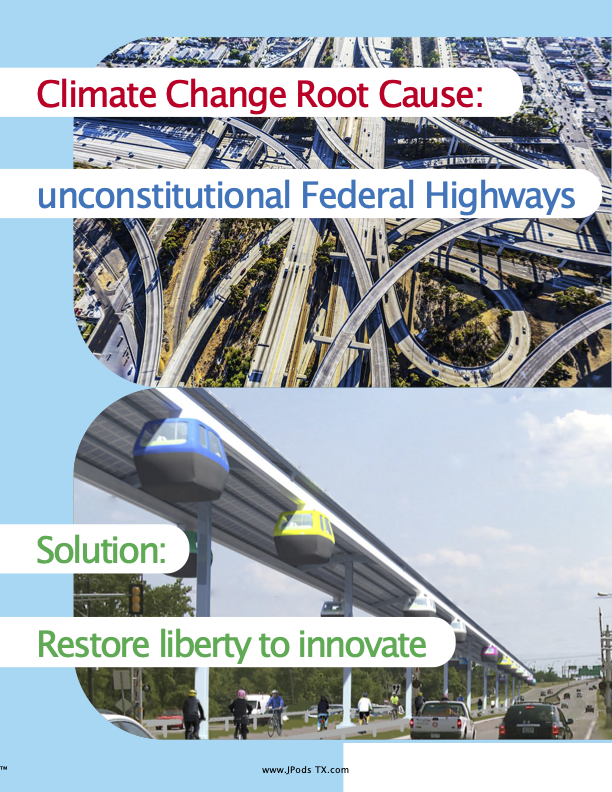
Climate Change Root Cause
The Boston Tea Party was a demonstration against government transport monopoly that triggered a war. The Constitutional Convention voted 8 states to 3 to forbid Federal Highways — yet they were built anyway, creating a repeating path to war, oil addiction, climate change, and $36 trillion in debt mortgaged against the future labor of our children.
Unconstitutional Federal Highways fragment communities, fund adversaries with petrodollars, and make walkable cities impossible. JPods is the correction.
Read the Book →City Assessment Tool
Enter your city and state — the tool looks up population, commute data, and traffic costs, then calculates the economic value of a JPods network: passenger-miles served, revenue potential, CO₂ reduction, and payback period.
Whether you're a city official, investor, journalist, or advocate — we'd love to connect. JPods provides funding for viable network proposals through the co-founder model.